1019.
The ingenious thing about the structure of the number system is the principle of repetition.
A counting is merely one single continuous repetition of the numerical alphabet, combined with an indication of the repetitions.
When we come to the number 9, we have used the whole numerical alphabet.
If we want to go on counting, we have to begin from the beginning until we once again come to the number 9, and so on continuously.
But in order to understand and give expression to our repetition of the use of the numerical alphabet, we also have to allow the repetitions to be included in the counting.
We indicate this counting of the repetitions by the numbers in front of the zero.
When, for example, we write the number 10, we are thereby expressing that we have already used the numerical alphabet for one round and are now about to begin to use the alphabet in a new round.
The number one therefore expresses the previous use of the alphabet, whereas the zero denotes the new or present use of the same alphabet.
When we write 11, 12, 13 etc., the same thing applies.
The number one still indicates the previous use of the alphabet, while the second number expresses how far we have come in the new use of the alphabet.
When the second use has been completed, we indicate it by placing a number two in front of the zero, just as we place a three in front of it when the third use has been completed, and so on.
The first number in the numerical word therefore expresses how many repetitions of the numerical alphabet we have completed, while the final number continues to indicate our position in the current repetition.
When we, for instance, write 52, this means that we are expressing that we have used the ten numbers of the numerical alphabet five times and are now at the third number in a new use of the alphabet.
In every counting we therefore have to count twice.
We count how many times we have used the alphabet before the current use, just as we also have to count how many units we have arrived at in this last-mentioned use.
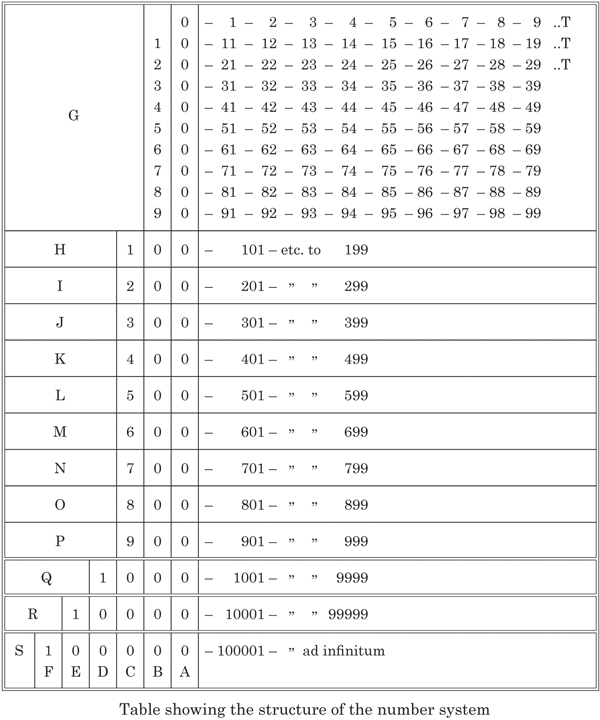
In the attached table, one can see these countings indicated by vertical and horizontal lines, marked respectively with the letters B, C, D, E, F and T.
To the right of the column with the zeros there appears the horizontal counting,
in which each of the 9 letters of the numerical alphabet constitutes a single unit, whereas the zero on the other hand does not count as a unit in itself but constitutes the "fixed point" in the number system.
When, for example, we write 10, it is not the zero that is counted, but the number one to the left of the zero.
It tells us that in front of the zero in this situation all the ten letters of the alphabet have been used.
This use is entered into the counting as a 1 in front of the zero.
But since in this situation there do not appear any units in a new use of the alphabet, this fact is indicated by a zero.
If we write, for example, 22, we are expressing the fact that in this situation there appear two whole uses of the alphabet plus the use of two units in a new use.
If we write 30, we have completed three rounds of the alphabet, but have not yet made use of any of the units in a new use of the alphabet and once again we have to indicate this with a zero.
As we have seen, there are therefore two countings, namely, one counting of the completed rounds of use of the alphabet and one counting of the single units or numbers that the rounds represent in each new and still not entirely completed round in the use of the alphabet.
Each time that we in our counting have used the 10 numbers of the numerical alphabet we can come no further, since the alphabet, due to the previously mentioned practical reasons, has no further numerical letters.
So, every time we come to the number 9, we have to write a zero again.
But in order not to lose sight of the nine units that, with the help of the numerical letters of the alphabet, we have acquired in our table we have to, again with the help of the letters of the numerical alphabet, hand them over to the new round of the counting.
And we do this by expressing these nine units with a number one, and by placing this one, as we have mentioned, to the left of the zero.
This number one differs from the number one on the right hand side of the zero in that it expresses a complete utilisation of the alphabet or a complete cycle, whereas the number one on the right hand side of the zero merely expresses the utilisation of one single unit or local point in the cycle.
But in the counting of all the completed rounds or cycles in the utilisation of the alphabet we arrive at the number 9 and have to begin with zero again.
(See the number columns to the left of the zero column).
And here we can observe the formation of a kind of cycle, in which each of the previously mentioned cycles constitutes merely a single unit.
These new cycles also have to be counted, causing us to once again arrive at the number 9, whereupon the counting has to go in cycles or repetitions that in turn cause new cycles to arise that appear in continuously larger and larger sizes stretching into infinity.
But since in every counting we therefore have to begin with zero and end with zero, this use of the ten letters of the numerical alphabet constitutes, as we have already mentioned, a "cycle".
Every counting is therefore a passage through repetitions of "cycles".
But since we in the case of each cycle take the value of the previous "cycle" into the new one, this latest "cycle" is not entirely the same as the previous one.
The counting is therefore not a continuous passage through the same "cycle" but is a journey through new interconnected "cycles" or "circles", and in this way it should be expressed as a passage through a "spiral cycle".


 Return to start page
 Previous
