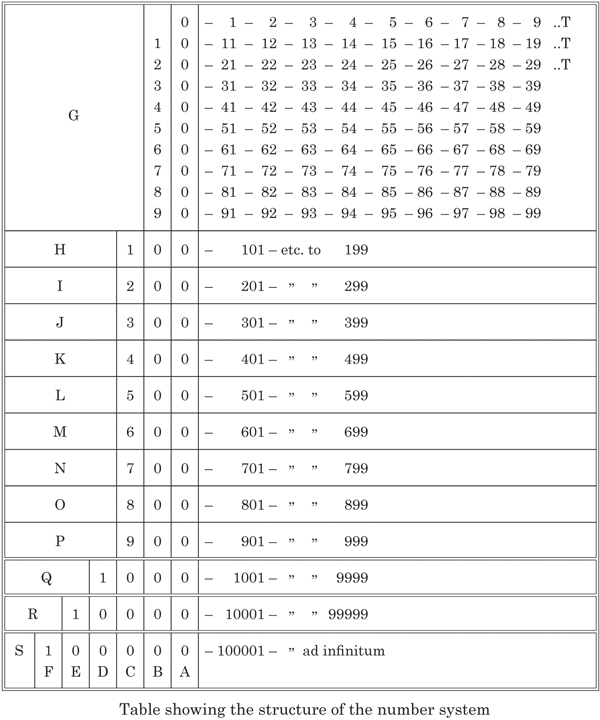
1021. Reading from the top downwards, the sequences of numbers in the columns to the left of the zero column indicate the actual number of cycles.
In this counting we also come to number 9 and have to continue with zero again, thus enabling us to witness that the number system goes on forming completely new cycles.
In these cycles the preceding cycles are simply units.
These new sections we have marked with the letters G, H, I, J, K, L, M, N, O, P.
Each of these new sections is made up of 10 cycles or 10 complete rounds in the use of the numerical alphabet.
Each of these rounds therefore comprises merely one unit of the new section.
These units are counted in the vertical series of numbers in column B, immediately to the left of the zero column (see section G).
But in this counting, we also come, as we have said, to number 9 again and so we have to use once again the number 0.
But when, in counting these units, we have completed one round in the use of the numerical alphabet, we must also in this counting indicate the fact by inserting a one before the zero.
And here in our counting to the left of the zero we also have the number 10.
But 10, that is to say, one and zero in front of the original zero – which constantly marks the starting point or the centre or "fixed point" of the counting – results in the numerical concept that we express as 100 (see section H).
The number 100 indicates that our counting represents one round in the use of the numerical alphabet in the counting of cycles, the units of which are composed of the individual numbers or numerical letters.
We find these latter cycles to the right of the zero column in the horizontal lines.
As these cycles are the first to be counted, we will express them as "1
st-degree cycles".
But as 100 in itself thus comprises one round in the use of the ten numerical letters of the numerical alphabet in the counting of cycles, 100 can also be characterised as a "cycle".
We have such a cycle in section G.
In this cycle each of the horizontal cycles or 1
st-degree cycles (marked T) comprises a unit.
The counting of these latter cycles is shown vertically in column B.
The section marked G therefore comprises, as we have mentioned, 10 of these cycles and thereby constitutes a cycle of larger size than 1
st-degree cycles.
We will therefore express such a section as a "2
nd-degree cycle".
But 10 of these cycles, that is to say the numbers from 0 to 999, will in turn form an even larger cycle.
We will express these as "3
rd-degree cycles".
In such a cycle each individual "2
nd-degree cycle" constitutes merely one unit.
The counting of the "2
nd-degree cycles" is shown vertically in column C.
And it is these cycles that are indicated in the sections G, H, I, J, K, L, M, N, O, P.
But, as we have said, 10 of these cycles make up a "3
rd-degree cycle".
This extends, as we have said, from 0 to 999 and appears in section Q and is enumerated vertically in column D.
But on account of the number system's principle of repetition 10 3
rd-degree cycles also form a cycle.
The first of these cycles extends from 0 to 9999 and is expressed in section R and is enumerated in column E as a "4
th-degree cycle".
10 of these large cycles in turn form a larger cycle, of which the first stretches from 0 to 99999 and is shown in section S and is enumerated in column F as a "5
th-degree cycle".
And just as we have seen that the structure of the number system has formed cycles of greater and greater degrees, so will this structure naturally continue to form larger and larger cycles for all eternity.
"6th-degree cycles" are equivalent to 1,000,000, "7th-degree cycles" equivalent to 10,000,000 and "8th-degree cycles" equivalent to 100,000,000 and so on.
For every number the counting adds to the left of the original zero, a cycle of a higher degree comes about.
And the structure of the number system is so ingenious that we can continue counting and counting in this way without ever coming to the absolutely final number, just as this same system reveals itself as being, as we shall see in due course, without any absolute "beginning".


 Return to start page
 Previous
