1032.
Every manifestation therefore gradually appears out of infinity and gradually disappears again into infinity.
It is therefore the part of an object that is one with infinity that we do not perceive or see and that we therefore sometimes express as "nothing" and, as far as life is concerned, as "death".
And it is this very part of the manifestation that we express as zero in the number system.
But since no form of "nothing" can possibly exist, the zero is thus in fact an expression of "something".
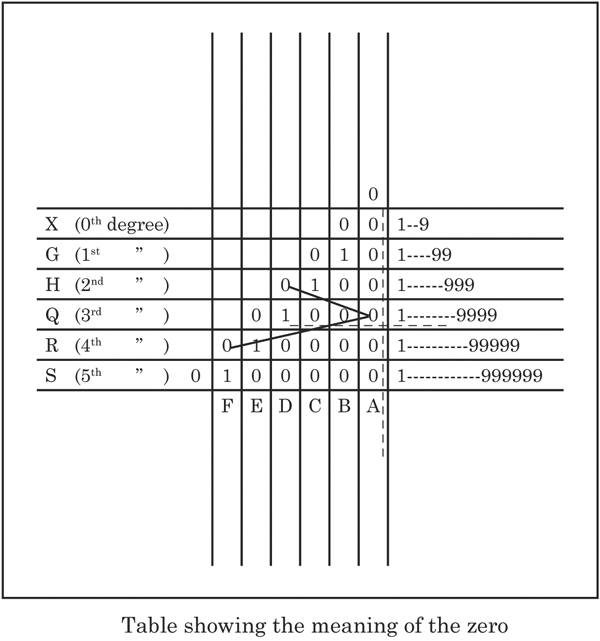
This is what we will be able to see in the special table showing the meaning of zero that follows.
The counting begins with the zero in the X section of the A column.
It is evident from our previous analyses that this counting takes place with the help of the ten letters of the number alphabet: 0, 1, 2, 3, 4 etc.
Each time these ten numbers have been used, the counting begins again from the beginning, but each time we have used the ten numbers of the alphabet, we have passed through a cycle.
Each of these cycles has to be put into the counting, and this occurs in the B column.
The numbers in this column, in connection with the zero in the A column, constitute the counting of the first cycles, and are expressed as 10, 20, 30, 40 etc.
The numbers to the left of the zero show how many times we have used the alphabet's ten numbers and express whole cycles (1
st-degree cycles).
In the table of the zero we can see the first cycle in this counting indicated by the number 10 in the G section.
But in this counting, we also come to the number 9 and we have thereby used all ten numbers of the number alphabet.
But in doing so we have, as the reader already knows, completed a new cycle (2
nd-degree cycle).
The counting of these cycles appears in the C column and are expressed as 100, 200, 300, 400 etc.
In the H section of the table we have the first of these cycles.
In this way the counting continues, as explained previously, by forming larger and larger cycles.
The next cycles (3
rd-degree cycles*) are thus counted in the D column and are expressed as 1000, 2000, 3000, 4000 etc.
The first of these cycles is placed in the Q section.
The next cycles (4
th-degree cycles) are counted in the E column and are expressed as 10,000, 20,000, 30,000 etc., the first of which we find in the R section.
In the table there is one more section showing cycles (5
th-degree cycles).
These are counted in the F column and are expressed as 100,000, 200,000, 300,000 etc.
The first of these is placed in the S section.
In its formation of ever larger and larger cycles the number system expresses exactly the same principle as that which makes the experience of life an eternally on-going journey through larger and larger spiral cycles.
____________
* "2
nd-degree" has been corrected to "3
rd-degree" in the original Danish.


 Return to start page
 Previous
