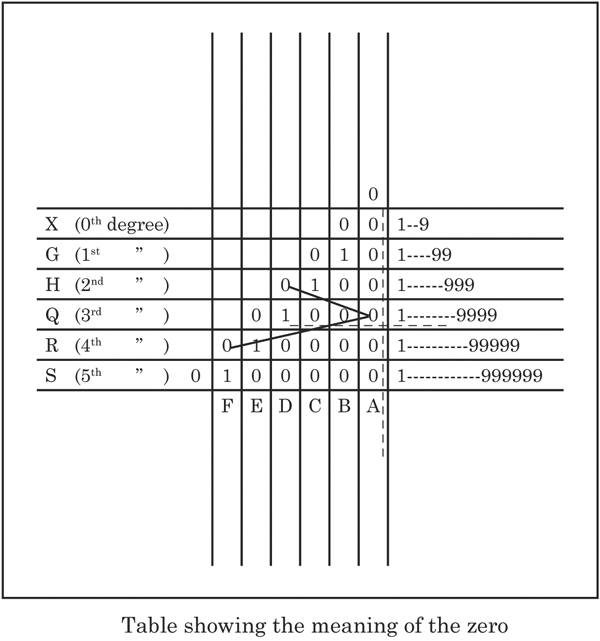
1034. This counting proceeds in the table's F column where the first cycle is indicated by a number one.
But this great cycle has not miraculously suddenly come into being out of "nothing".
It has come about only gradually by counting 99,999 units or by completing 10,000 1st-degree cycles, or 1000 2nd-degree cycles, or 100 3rd-degree cycles or 10 4th-degree cycles.
None of these units or cycles can form a 5th-degree cycle as long as even one unit is missing.
All these units are present in the R section in the table, but this section is actually the expression of 4th-degree cycles, that is to say, it is the place where all the units below and including the number 99,999 belong.
This section is therefore, in a way, full, and according to the structure of the number system cannot contain any more.
The number nine is the alphabet's final number.
And any further counting consequently has to return once again to the first letter or number in the number alphabet, namely zero, and from there continue with a new use of the alphabet's numbers, namely 1, 2, 3, 4 etc. up to 9.
This new use of the numerical alphabet must inevitably form a new section in the counting.
And it is this new section that we have marked as section S.
The R section in reality contains the contents of the first 5th-degree cycle, but as we have seen it cannot be counted there, which is indicated by the zero in the F column in this section.
The first cycle of the S section is therefore gradually created within the R section.
But here it is not independent; here it does not count.
Here it is like an embryo in the mother's womb that slowly and naturally grows towards its birth.
In passing the number 99,999, it is finished with the R section and passes over as an independent unit into a new cycle.
This passing of this number is the same as its "birth".
After this it has become a unit in a new and larger cycle or section, which in turn will be a mere unit in a still larger cycle or section, and so on continuously.
But in reality, this "birth" cannot come about without also being an expression of "death".
The connection between the zero and the R section has ceased to exist, which was absolutely necessary in order for the zero to be released from this section and become an independent unit in a larger cycle.
The R section therefore has ceased to exist, but its numerical value in the form of the number one has been carried over to the new position of the zero.
But is this not precisely a picture of the living being's "death"?
Here the zero is an expression of the living being's I, while the R section is the organism it has outlived and the worn-out life form connected to it.
At "death" the I separates from this organism and the worn out, physical life form it has been connected to, but takes with it the value of its experience in the form of talent kernels into the new existence, which is then characterised or shaped by the talents emerging from these talent kernels.
The numbers therefore in fact express that an absolute death does not exist for the I itself, but only for "created things", which means for that which has never ever been "living".
But since in its absolute sense "death" can befall only that which is already dead in advance, it is an illusion.
It can take place only in the form of a "new birth".
But the numbers also express that "birth" in the absolute sense, that is, as something identical to the creation of a new I, is also an illusion.


 Return to start page
 Previous
