688. Our experience of life unfailingly constitutes a sense of a centre that gathers together the reactions of the contact between our organism and the influences of Nature, or the phenomena we call sensory impressions.
It is an irrefutable fact that "we" experience "our" own sensory impressions.
"We" experience our contact with reactions to light through "our" eyes, just as "we" experience reactions to sound through "our" ears, and reactions to smell, taste, feeling and thought through the corresponding sensory tools that are adapted for the purpose.
Who or what is expressing this "we" or "our"?
If the ability to experience can exist only independently, these expressions would be quite meaningless.
If there is not "something" that sees, hears, smells, tastes and so on, such expressions as "we" see, "we" hear, "we" smell or "I" wanted to, "I" did not want to, "I" ran, "I" experienced and so on could never have existed.
If the only thing that existed was the faculty to experience, the expressions "we", "our" and "I" could be expressions of only something that absolutely does not exist.
And our everyday remarks about our own I would have to be the greatest falsehood that could ever possibly be manifested.
But what would be the purpose of this meaningless falsehood?
Does not the denial of the existence of our own I or self reveal itself to be a one hundred per cent superstition?
Why say "I" saw, if you at the same time want to explain away or deny the existence of this "I"?
If this "I" did not exist there would be nothing that saw, nothing that heard, nothing that wanted or could.
To claim that it is the brain that is put together in such a way that it can experience and sense is merely an expression of the fact that one is mentally still floundering in the endless temporal chain of cause and effect.
The sensory faculty is in this case just a combination of effects, of which the brain is the cause.
But as the brain also proves to be a created reality, intended to fulfil a planned purpose, it is in itself, as well as being a new combination of effects, also undeniably to be acknowledged as just as dependent or subordinate a reality as the faculty to sense or experience.
In other words, it reveals itself as being identical to a function.
But if it is a function, there is as little justification in our using the term "I" about it as about the sensory faculty.
And the most correct thing, instead of saying "I", would be to say, "the function" saw, "the function" heard, "the function" experienced, which would in turn mean "the experience" experienced.
But what experienced the experience?
It could in fact only be "the experience" that experienced.
And there would be nothing else whatsoever in existence but that.
That this does not take into account the terrestrial human being's full recognition of the real truth of this issue becomes a fact through the circumstance that here the beings use the terms "I" or "we", and must continue to use these terms, even while actually denying the existence of the I.
Can one imagine a more compromising situation than that a "something" proclaims the assertion that it has never existed?
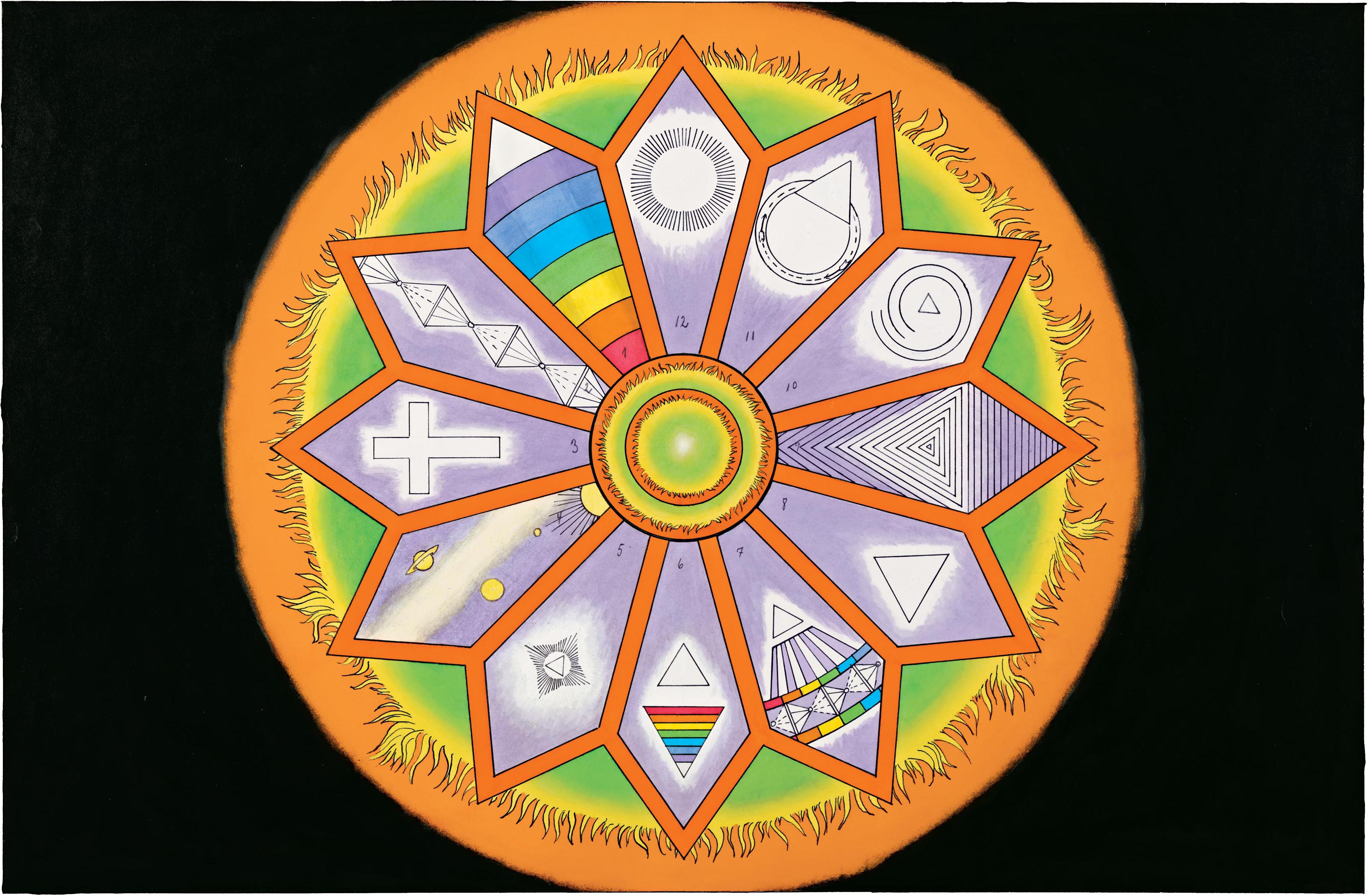
Symbol no. 11
The Solution to the Mystery of Life


 Return to start page
 Previous