719. It is true that, to the terrestrial human beings' consciousness, there is such an endless amount of what seems to be chaos, but this constitutes merely the cloak that covers every object as long as one is unable to see through or reveal it.
Who would not see a construction site, with its jumble of containers, ladders, scaffolding, lime, cement, rubble and so on, as absolute chaos, if they had not the vaguest idea of the purpose of the project?
Is it not the same in the case of a complicated factory's confusion of wheels, appliances and machinery?
Do you think an inhabitant of Tierra del Fuego or a pigmy would be able at first glance to find any logic or plan in this?
"Chaos" is the cloak that every object is wrapped in when it first comes into contact with a sensory faculty.
If we see or perceive something as "chaos" it means that this object is merely to be found in the forecourt or outermost periphery of our sensory area.
It is still confined within the misty haze of the far distance.
Here one might raise the objection that one can very well have "chaos" at very close quarters in the sensory area, in fact one can even consciously create "chaos".
But who releases energy and effort with the sole purpose that this release must serve no purpose whatsoever?
Would one not be abnormal, that is to say mentally deranged, if one were the originator of such a release?
Is not mental derangement the same as seeing things in chaos or in a fog?
Here one might raise the further objection that when one is at war, one is to a large extent consciously creating "chaos" using guns, bombs and shells, and that this "chaos" cannot be the result of sensory perception at a distance since many people experience this "chaos" at alarmingly close quarters.
But the answer to this must be
that the chaos of war is not carried out by its originator with the object of it not serving a purpose; on the contrary, it is intended to serve the purpose of restraining or disarming the opposition.
But in that case, it is not "chaos".
Whoever calls this "chaos" is not able to survey the phenomenon as a whole.
And lack of ability to survey as a whole is the same as sensory remoteness, which invariably causes every object to appear as "chaos".
The concept of "chaos" can therefore never in any situation whatsoever justifiably describe anything other than sensory remoteness.
Nature knows nothing of creating absolute "chaos".
And it is impossible for the beings to create chaos consciously without having lost control of their senses or by being abnormal.
So perfectly finely drawn are Nature's methods of creation that even the "chaos" produced by the beings' abnormality is drawn into Nature's great creative process as something useful, and this thereby renders absolute "chaos" an impossibility.
"Chaos" is and will therefore remain in the absolute sense merely a relationship of cosmic perspective, and thereby constitutes merely a phenomenon of thought, an imaginary opposite of the reality that shines around us as a fact.
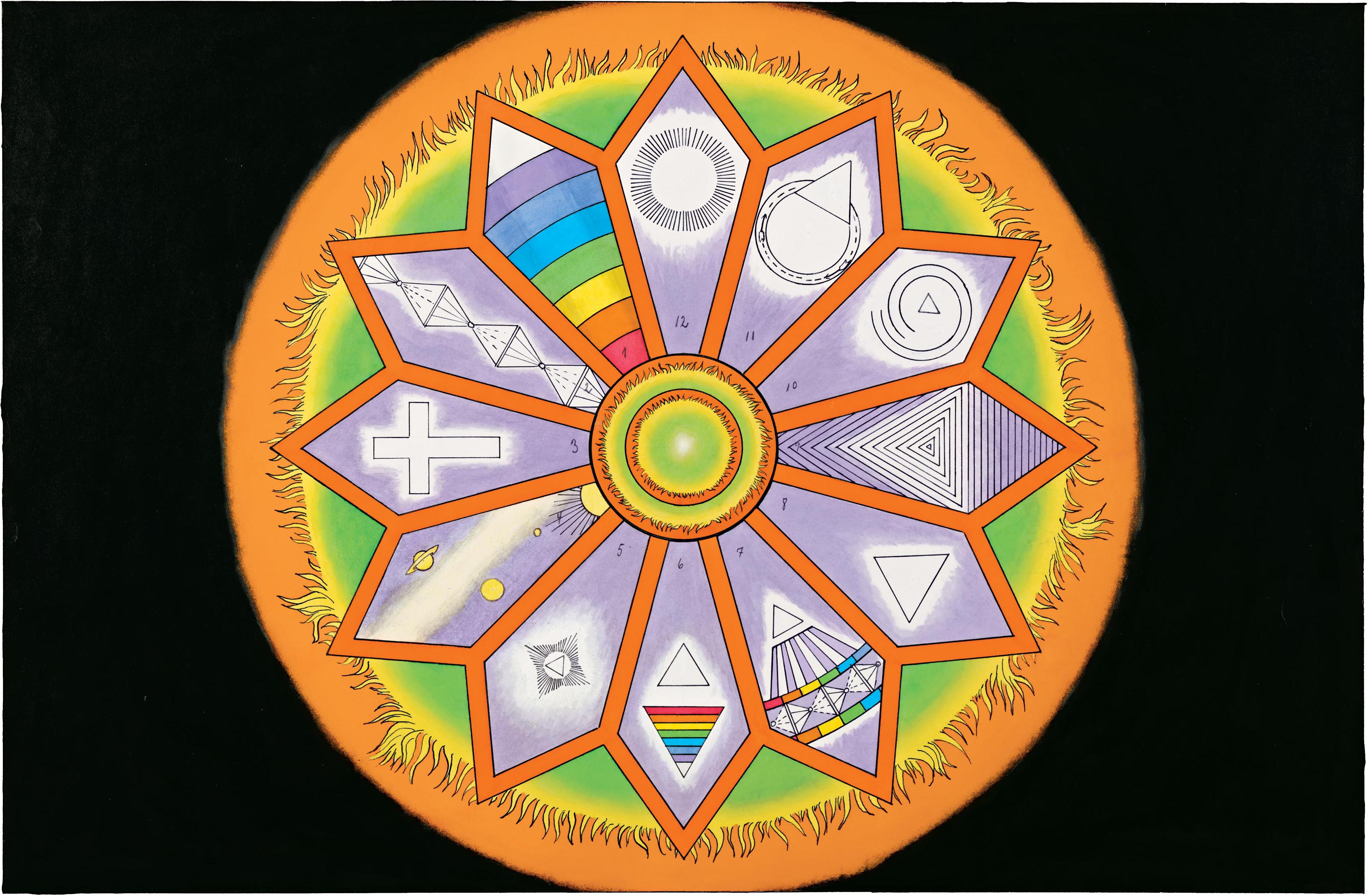
Symbol no. 11
The Solution to the Mystery of Life


 Return to start page
 Previous