759. The living being's relationship to the Godhead or to Providence therefore appears, as we have shown, in two different forms.
We can call the first of these a "bodily" and the second a "verbal" form of appeal.
The "bodily" form of appeal finds expression in our daily interaction with and relationship to our neighbour and constitutes all the purely practical experiences, while the "verbal" form of appeal constitutes everything that comes under the concept of an "intimate prayer" or a direct, solitary appeal to the Godhead.
Gradually, as harmony comes about between the "bodily" and the "verbal" appeals to the Godhead, this will begin to be a living reality for the son of God.
But before this can come about, the "bodily" interaction with the Godhead must be identical to a thorough understanding and the resulting tolerance or love towards one's surroundings or neighbour, while the intimate or "verbal" interaction must be "in secret", which means it must be concentrated or focused directly on the Godhead itself, as if on a living being, and on nothing else whatsoever.
If there is any concentration on anything else, whatever it may be, it in fact belongs to the "bodily" appeal and can thereby only distract or weaken the concentration or the intimate focus and consequently impede the being's senses in the reaction that is a sign of the experience of the Godhead as a truly living being.
It goes without saying that it is therefore necessary to be alone during one's intimate prayer.
Prayers that are held in public gatherings can never be of such an intimate or heartfelt nature as those held quietly in solitude.
That any prayer is totally without meaning or logical justification there where it constitutes a manifestation of pharisaical pride and appears as a public parade is naturally a matter of course.
In that case it will form part of our entire outward way of being or our relationship to our neighbour, that is to say our "bodily" appeal to the Godhead.
Unless this outward "bodily" appeal is just as consciously focused on the Godhead itself as in the secret closet, one should not expect to experience a truly living, personal relationship between oneself and the Godhead.
What is the use of praying to God for this or for that, either intimately in one's secret closet or openly in public gatherings, if, with one's willpower and bodily strength, one manifests only egoism, anger, hate and slander, indeed murders and kills if not human beings then vast numbers of animals, under the pretext that it is necessary for one's daily nourishment, even though these killings are in fact no longer a vital necessity in a truly civilised society?
What good does it do that in one's secret closet, with an authorised prayer or with adulation, praise and eulogising, one tries to convince the Godhead of one's virtues and good intentions, if in one's everyday way of being more or less in the form of selfishness, indignation and persecution one hits out in all directions against one's neighbour, thereby revealing to the Godhead that the opposite is the case?
We must constantly remember that our neighbours are the Godhead's absolute, true sensory tools.
What we do to these "sensory tools" is the Godhead's only real material with which he can analyse and assess of our true being and the genuineness of our authorised or intimate prayer.
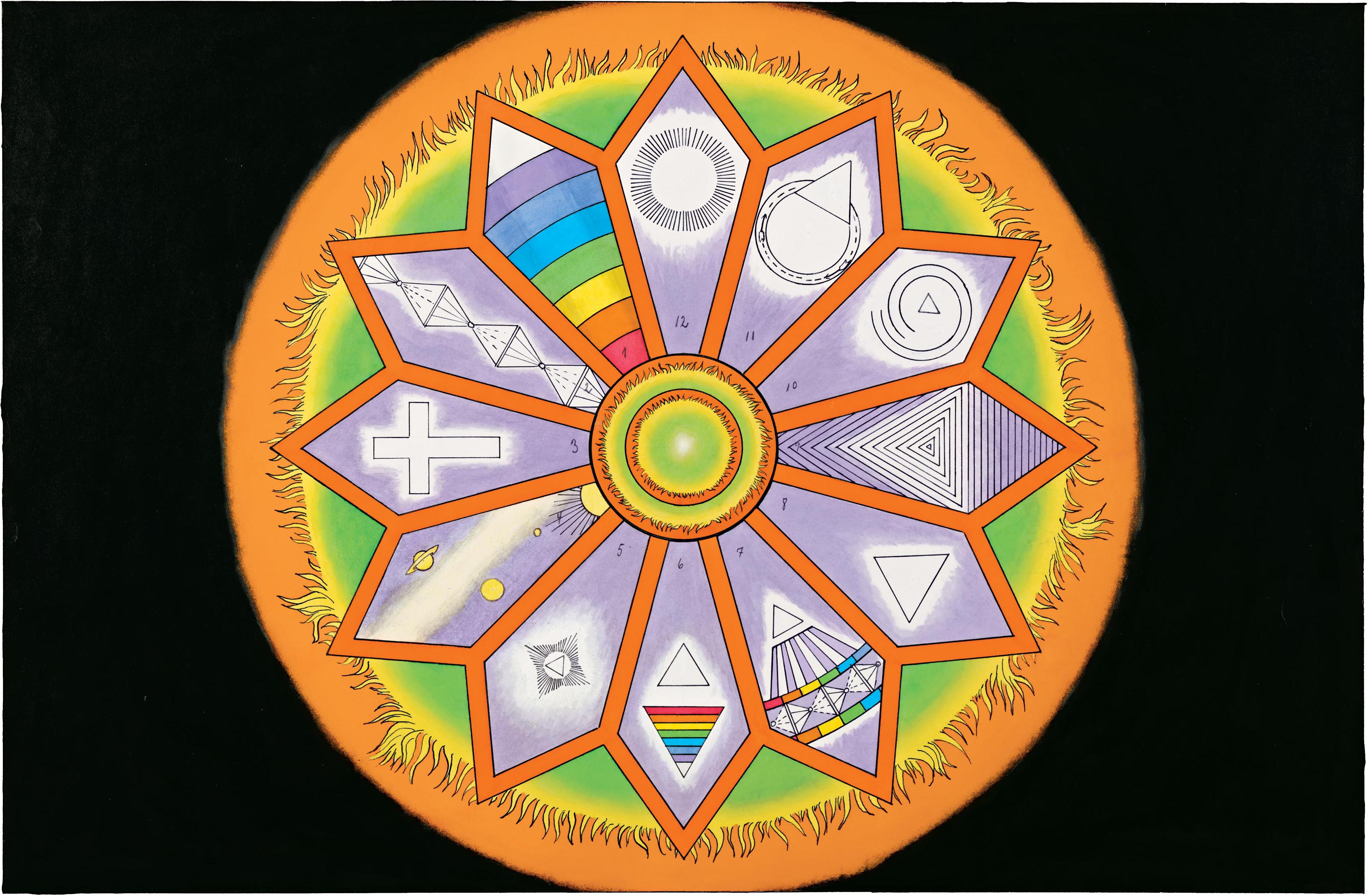
Symbol no. 11
The Solution to the Mystery of Life


 Return to start page
 Previous